

For more than a month, Luna was somewhere inside Yellowstone National Park.
She was small.
She was alone.
And around her were grizzly bears, wolves, coyotes, freezing nights and thousands of acres of wilderness.
Her family had no idea if she was still alive.
Then came another sighting.
And another.
Somehow, the 10-year-old Jack Russell mix kept surviving.
She vanished from a cabin
Luna disappeared on September 10 while her California family was visiting Yellowstone.
According to rescuers, the family had left her safely inside a locked cabin in Canyon Village while they visited an area where dogs were not allowed.
A “Do Not Disturb” sign was on the door.
But housekeeping entered.
Luna escaped.
By the time her family returned, she was gone.
Searches began immediately.
But Yellowstone is not an ordinary neighborhood.
It is enormous, wild and full of animals capable of killing a small dog.
People kept seeing her
Luna did not disappear completely.
Visitors and employees reported seeing her crossing roads, moving through staff housing and even entering lodges through automatic doors.
But every time someone tried to approach her, she ran.
That became one of the biggest challenges.
Rescuers repeatedly warned people not to chase her or call her name because a frightened lost dog can enter a survival state and flee even from people trying to help.
Luna kept moving.
And winter kept getting closer.
The clock was running out
Katie Boucher, president of Norris Ark Training and Recovery Center, became one of the key people coordinating Luna’s recovery.
By October, temperatures were dropping and snow had begun appearing in the park.
The seasonal campground where Boucher was staying was about to close.
Searchers knew they were approaching the point where continuing would become nearly impossible.
Luna had already survived more than a month.
Nobody knew how much longer she could keep doing it.
Food could attract the wrong animal
A normal trap baited with food created another problem.
Yellowstone is full of wildlife.
Food could attract bears, coyotes or other animals before Luna ever reached it.
So rescuers tried something more personal.
They used scent from her own family.
A T-shirt.
A pillowcase.
Familiar smells from home.
The trap was placed near an area where Luna had been repeatedly spotted.
Then they waited.
Luna finally went inside
On October 14, the plan worked.
Luna entered the live trap.
She was finally safe.
Her owner flew in from California and reunited with her shortly afterward.
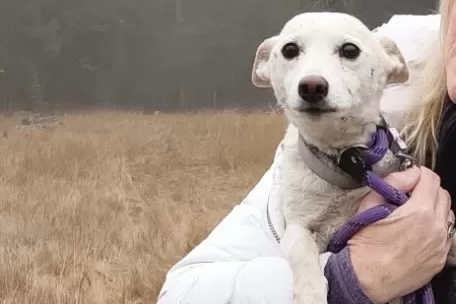
Photos from that day show Luna being held in her owner’s arms after more than a month in the wilderness.
She was badly underweight.
Some reports said she had lost nearly half her body weight.
But she was alert.
Alive.
And finally going home.
Nobody knows exactly how she survived
Luna’s earlier life as a stray may have helped.
Rescuers believe those instincts could have allowed her to find food, water and shelter while avoiding predators and people.
But much of what happened during those weeks remains unknown.
Only Luna knows where she slept.
What she ate.
How close she came to danger.
Or how many nights she spent moving through one of America’s wildest landscapes.
What is known is that she kept going.
For more than a month.
Until one familiar scent finally led her somewhere she did not need to run anymore.
Home.