

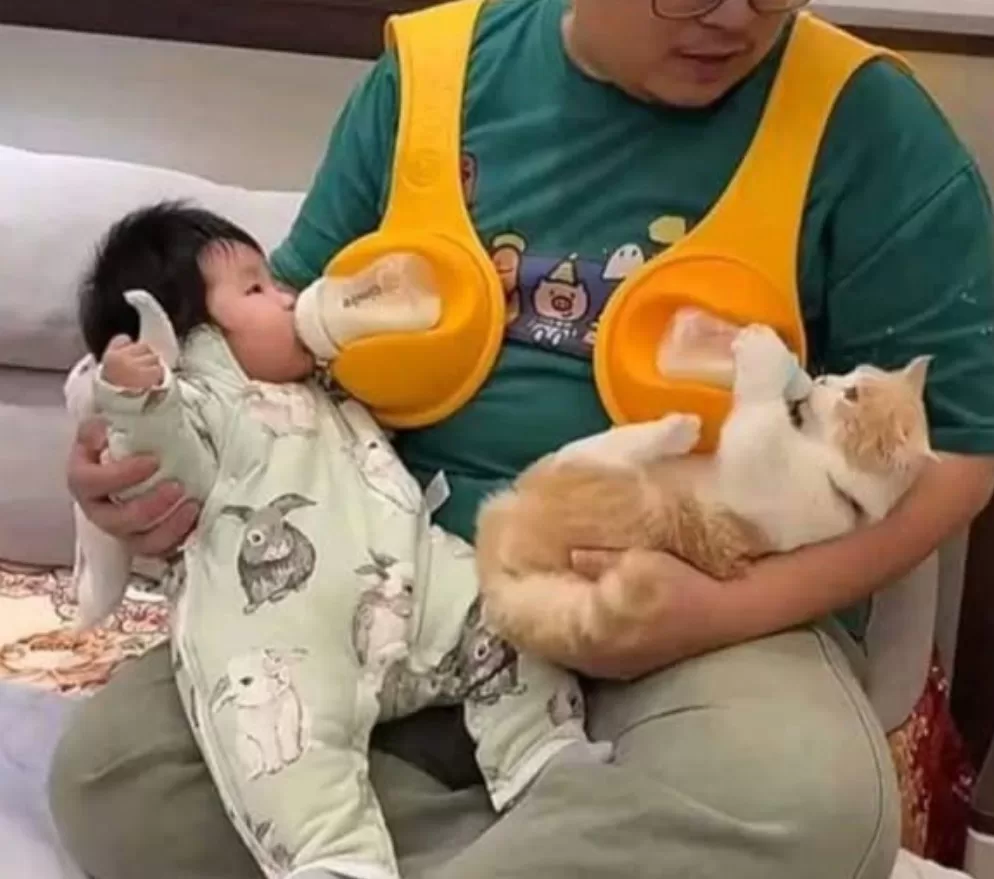

Two Hungry Babies and a Caring Father: A Moment of Shared Tenderness
The image captures a tender and slightly humorous moment: two babies, both hungry, both depending on the same pair of hands.
In one arm rests a small infant, drinking from a bottle with quiet focus. In the other lies a fluffy kitten, equally determined, reaching toward its own bottle. Between them sits a father, calmly managing both, making sure that neither feels forgotten.
The scene is simple, yet it speaks volumes about care, responsibility, and adaptability.
Parenthood often comes with unexpected challenges. Feeding one baby can already require coordination, patience, and attention. Feeding two at once, even when one of them happens to have whiskers and paws, adds another layer of complexity.
Yet in this moment, there is no sign of stress. The father looks composed, attentive, fully present. He supports the human child securely while ensuring the kitten also receives nourishment. It is a quiet demonstration of multitasking driven by compassion.
The phrase says it perfectly: “Zwei hungrige Babys und ein fürsorglicher Vater!”
Although one baby is human and the other feline, the emotional message is the same. Care does not discriminate. When responsibility is accepted, it extends to all who depend on you.
Animals, especially young ones, require consistent feeding and warmth. A kitten separated from its mother must be bottle-fed regularly, often every few hours. That commitment demands patience and discipline. Combining that with the needs of an infant highlights the father’s willingness to meet every responsibility head-on.
There is also something heartwarming in the shared vulnerability of the moment. Both the baby and the kitten rely completely on the adult holding them. Neither understands the complexity of what is happening. They simply trust.
Trust is built through repetition. Through feeding, holding, comforting. Whether human or animal, young beings form attachment based on consistent care. In this case, both find security in the same set of arms.
The image also gently challenges conventional roles. Caregiving is sometimes narrowly associated with mothers. Yet fatherhood carries equal capacity for tenderness and competence. The calm expression, the careful positioning of bottles, the balanced posture all demonstrate that nurturing is not defined by gender but by action.
It is easy to overlook how meaningful small moments like this can be. Feeding a baby is routine. Feeding a rescued kitten is a task. But together, they form a snapshot of dedication.
The kitten likely arrived in the household needing special attention. Perhaps it was orphaned or too young to eat independently. Instead of treating the responsibility as a burden, the father integrates it into daily life, even alongside the demands of caring for an infant.
In doing so, he models something powerful: empathy that extends beyond species boundaries.
For the children growing up in such an environment, compassion becomes normal. Caring for animals alongside family members reinforces the idea that kindness is universal.
In the end, what stands out most is balance. Two small lives, equally hungry, equally dependent. One caregiver responding without hesitation.
It is not dramatic. It is not extraordinary in a loud way. It is simply a father making sure that everyone in his arms feels safe and fed.
And sometimes, that quiet dedication is the most meaningful form of love.


