


The Snow Mound That Breathes: A Bernese Mountain Dog’s Love for Winter
At first, the garden looks like any other peaceful winter scene. A smooth, white blanket of snow stretches across the ground without a single footprint. Everything is still. Everything is quiet.
Except for one odd shape in the corner.
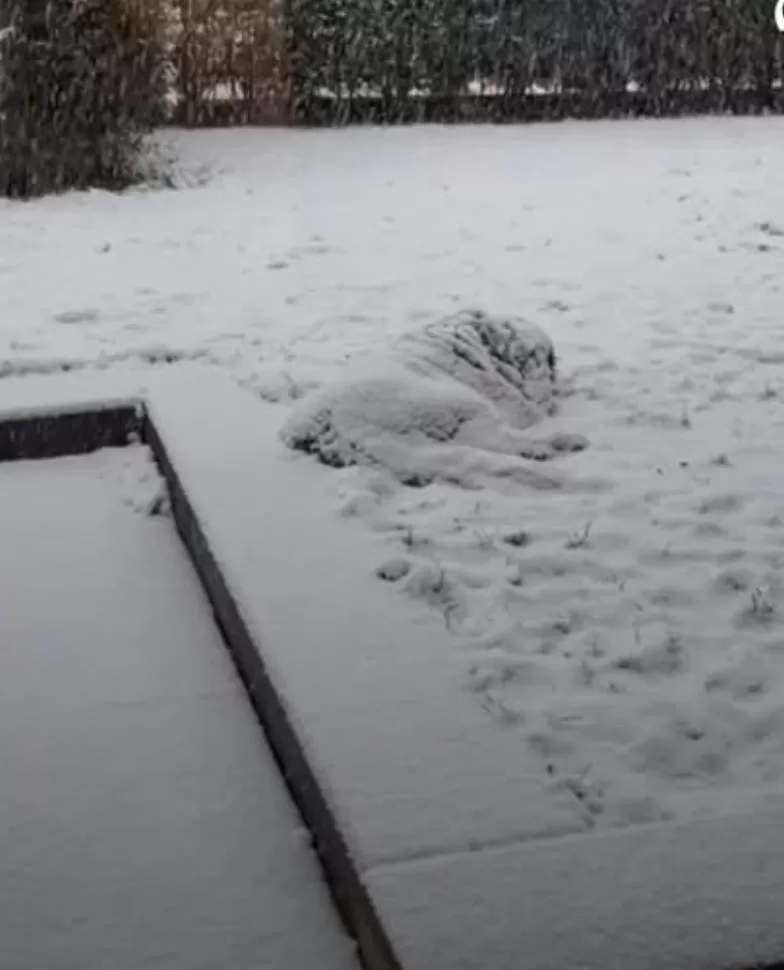
There, interrupting the flawless surface, lies a strange mound. It looks like a random pile of snow, uneven and slightly darker than the rest. Half shadow, half drift.
But this snow pile breathes.
Every time it snows in Liz Vanderbrouk’s garden in Switzerland, the same sight appears in the exact same spot. Over the hours, as the snow continues to fall, the mound grows thicker and more rounded. Wind blows. Flakes settle. The shape remains motionless.
Until suddenly, a large head rises from the white blanket and turns toward the house.
It is Carl, Liz’s ten-year-old Bernese Mountain Dog, who loves fresh snow more than anything else in the world.
Carl lifts his head briefly, blinking through the falling flakes. He looks directly toward Liz, offering what can only be described as a contented dog smile. As if confirming that she is watching, he lowers his head again and disappears back into his snowy nest.
Inside the house, a very different winter philosophy unfolds.
Carl’s five-year-old “brother,” Steve, a Newfoundland, has a much more practical relationship with snow. He steps outside, sniffs around for a moment, perhaps tastes a few flakes, sits briefly, and then quickly returns indoors. While Carl buries himself in the cold, Steve prefers the warmth of the fireplace, curling up comfortably on a rug.
Two dogs. Two entirely different ideas of happiness.
Liz knows Carl’s winter habit well by now. She regularly checks on him to make sure he is alert and comfortable. With his dense coat and sturdy build, he is naturally equipped for cold temperatures. Bernese Mountain Dogs were bred to thrive in alpine climates, and for Carl, snow is not discomfort. It is joy.
As the snowfall continues, his dark fur gradually disappears beneath a thick layer of white. At times, only the faint outline of his body is visible. Eventually, even his muzzle becomes dusted in flakes.
When Liz finally calls him inside, he rises slowly, shakes off a cascade of snow, and trots toward the house. Once indoors, she dries him with a large towel and offers him a treat as a reward. Carl accepts it calmly, likely already anticipating the next snowfall.
The scene offers a gentle reminder that happiness is not universal in form. For one dog, comfort means firelight and warmth. For the other, it means lying still beneath falling snow, immersed in the cold.
Animals, like humans, experience joy differently. Some seek warmth and security. Others find peace in elements that might seem uncomfortable to outsiders. Carl’s quiet devotion to his snowy bed reflects individuality, not stubbornness.
There is something poetic about the image of a snow mound that quietly breathes. To anyone looking out from the window, it might appear as part of the landscape. Yet hidden beneath that white covering is contentment in its purest form.
Perhaps the next time you look at a winter garden and notice an unusual shape beneath the snow, you might wonder what it hides. Sometimes, what appears ordinary from a distance is simply someone experiencing their own version of happiness.
For Carl, that happiness falls from the sky in silent, white flakes.


