


The Clever “Decoy” That Fooled Me for Two Hours
Sometimes the smallest moments in life turn into the ones you remember the longest.
It was an ordinary evening. Calm, comfortable, nothing unusual. My dog had been lying near me, as he often does, settled into his favorite soft bed. The room was quiet. I glanced over a few times, catching what looked like his familiar shape curled into the cushion.
Everything felt normal.
At some point, he must have quietly slipped away.
But I did not notice.
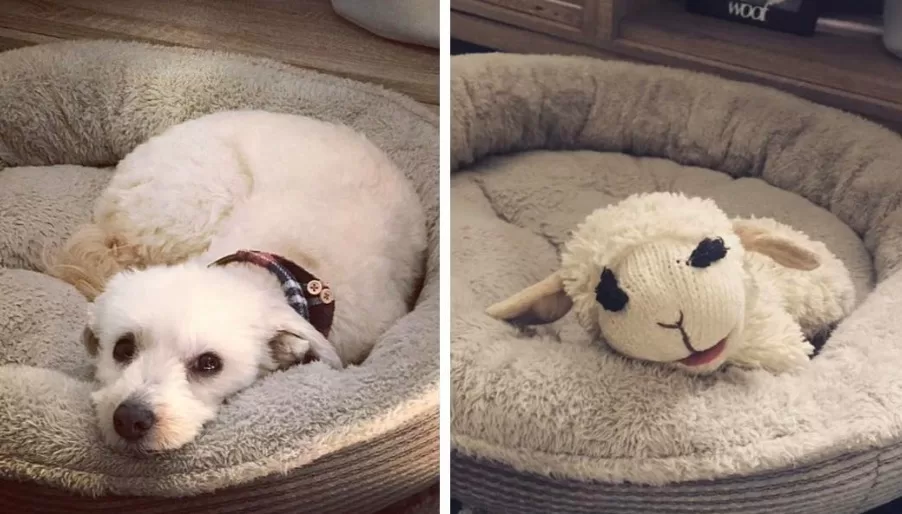
For nearly two hours, I was convinced he was still there beside me. The soft, rounded shape in the bed looked exactly like him. The gentle curve of what I thought was his body, the placement of what seemed like a head resting against the plush rim, the subtle shadows in the dim light. My brain filled in the rest of the details automatically.
It was only when I finally stood up and walked closer that I realized something was off.
The “dog” in the bed was not my dog at all.
It was a stuffed lamb toy.
Perfectly placed. Curled into the same position he often uses. Tucked neatly into the cushion, as if it had intentionally been arranged to resemble him. In that soft lighting, from across the room, the resemblance had been convincing enough to fool me completely.
Meanwhile, my very real dog had already gone to his own room.
He had quietly excused himself from the evening without any announcement. No dramatic exit. No scratching at the door. Just a silent departure. And somehow, he had left behind what looked suspiciously like a decoy.
Of course, he did not intentionally stage an elaborate trick. Or maybe he did. Anyone who lives with a dog knows they are far more observant and clever than we often give them credit for.
What struck me most was how easily I accepted what I thought I saw.
I did not question it. I did not double check. I simply assumed he was still there because that was what I expected. The shape matched the memory in my mind. The routine matched my habits. So I let my perception fill in the blanks.
It is funny how often we rely on patterns.
We see a familiar outline and assume it is the same presence. We expect warmth, so we imagine it. We trust our first glance instead of verifying it. In that quiet room, with soft light and a calm atmosphere, my brain decided that the stuffed toy was close enough to reality.
And for nearly two hours, I believed it.
When I finally found him in his room, fast asleep and completely unconcerned with the confusion he had left behind, I could not help but laugh. There he was, comfortable and relaxed, probably wondering why I had not followed sooner.
The bed in the living room, meanwhile, still held the plush lamb. Innocent. Motionless. Completely unaware of the role it had played in this minor domestic illusion.
The whole situation felt strangely symbolic.
Dogs move through the house in their own quiet rhythms. Sometimes they stay close. Sometimes they retreat to their own space. They do not need to explain it. They simply exist in the moment.
And we, as humans, project continuity onto them. We assume presence. We assume proximity. We assume the shape in the corner of our vision is the companion we are used to seeing.
Until it is not.
In the end, nothing dramatic had happened. No emergency. No loss. Just a small misunderstanding between perception and reality. But it left me smiling for the rest of the night.
It reminded me how much of our comfort comes from simply believing someone is nearby. Even when they are not physically next to us, the idea of their presence can feel enough.
My dog had gone to his room.
But for two full hours, I felt like he had never left.
And perhaps that says more about attachment than about clever decoys.


