

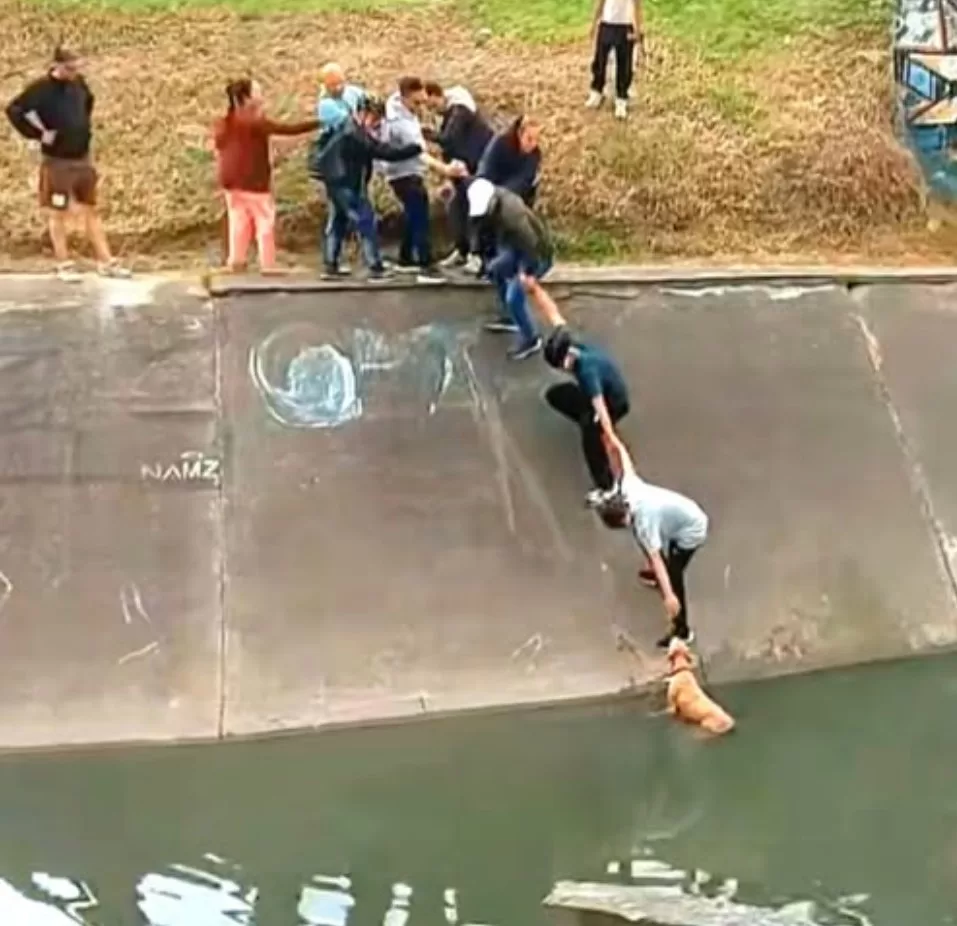

Neighbors Form Human Chain in Bogotá to Rescue Dog from Canal
A few days ago, Nicolás Gallardo was doing what he often does, walking his dog through the streets of Bogotá. It was an ordinary outing until he sensed that something was wrong. From the direction of a canal in the El Tintal neighborhood, he heard raised voices, urgent calls, and people speaking over one another.
Curious and slightly uneasy, he moved closer to see what was happening.
At the edge of the canal, a group of local residents had gathered. All eyes were fixed on the water below. Clinging desperately to the steep concrete wall was a terrified dog. The slope was smooth and high, offering no grip. The animal had nowhere to climb. Each small wave and movement in the water caused it to slip slightly, bringing it closer to exhaustion. The risk of losing its hold and drowning was real.
The situation was critical.
Yet instead of standing by or simply recording the scene, the neighbors did something increasingly rare: they worked together.
Without long discussions or hesitation, one person reached for another’s hand. Slowly, they formed a human chain, carefully lowering themselves down the canal wall. Each individual relied entirely on the strength and stability of the others. One man positioned himself at the lowest point, stretching his body as far as he could toward the struggling dog.
The tension was visible. Those above held firm, arms tight, hearts racing. No one wanted to slip. No one wanted to lose balance and risk turning one rescue into multiple emergencies. It was a delicate coordination of strength and trust.
Nicolás stood on the opposite side of the canal. He could not cross to assist. There was no safe way for him to join the effort. So he did the only thing he could: he recorded the moment.
On his video, the human chain slowly begins to rise again. Inch by inch, the soaked and trembling dog is lifted upward. The group maintains steady focus until finally, the animal is pulled safely over the edge and onto solid ground.
Miraculously, the dog appeared unharmed.
Shortly after the rescue, it was reunited with its owners, who lived nearby. For them, it was their beloved pet returned to their arms. For countless others who later watched the video online, it became something more.
The footage quickly spread across social media platforms. Viewers commented that the scene restored a sense of faith in humanity. In a time when many viral videos capture indifference or conflict, this one highlighted cooperation and empathy.
What makes this rescue so powerful is its simplicity.
There were no uniforms, no official rescue teams, no special equipment. Just neighbors responding instinctively to a life in danger. The decision to act was immediate. No one asked who was responsible. No one debated whether it was worth the risk. They simply chose not to look away.
Animals in urban environments often face unexpected hazards. Concrete canals, drainage systems, and steep embankments can become traps, especially after heavy rain. Without intervention, many situations like this end tragically. The difference in this case was collective action.
The image of people linked together, relying on each other’s strength, carries a broader message. It shows how ordinary individuals can become extraordinary when they cooperate. Each person in that chain mattered. Remove one link, and the rescue might not have succeeded.
For Nicolás, capturing the moment was not about attention. It was about showing what neighbors are capable of when it truly matters. His recording turned a local rescue into a shared reminder that compassion still exists.
The story does not portray dramatic heroism in the traditional sense. There were no grand speeches or public recognition. There was simply a group of people who refused to let a frightened animal slip beneath the surface.
Perhaps that is the deeper lesson of the day.
You do not need to be a hero in the conventional sense. It is enough to step forward instead of turning away. Whether it is a person or an animal struggling, what matters most is the willingness to act.
In Bogotá’s El Tintal neighborhood, a human chain formed not out of obligation, but out of care. And for many who watched from afar, it became a quiet symbol of hope.


