


The Quiet Ways Trauma Shows Up After Rescue
The first time I saw Max at the shelter, he was curled up at the very back of his kennel. His body was tight, as if he was trying to make himself smaller than he already was. He lifted his head only slightly, just enough to look at me with large brown eyes filled with uncertainty. It was the kind of look that suggests experience, not innocence. The kind that expects things to go wrong at any moment.
The staff told me he had been there for months.
Always waiting. Always overlooked.
Max had come from a bad situation. Neglect, possibly mistreatment, and finally abandonment by the only people he had ever known. By the time he arrived at the shelter, trust was no longer something he offered easily. Or at all.
He was afraid of loud noises. Afraid of sudden movements. But more than anything else, Max was terrified of being alone.
Bringing him home was not the happy, cinematic moment people often imagine when they think about adoption. Max did not understand what was happening. He paced through the apartment restlessly, sniffing every corner as if searching for something familiar that did not exist anymore. He barely ate. He barely slept. And every time I left the room, even just briefly, I heard a soft whimper behind me.
It was not dramatic. It was worse than that.
It was quiet panic.
As if his body immediately flipped back into survival mode the moment I disappeared from view.
Then came the pacifier.
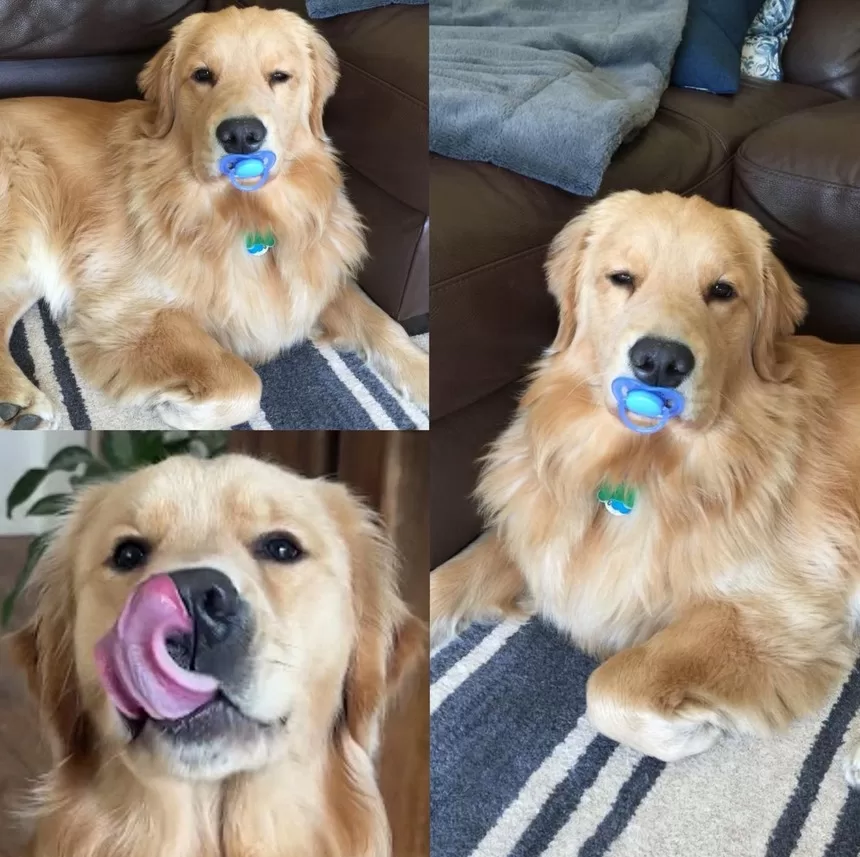
To this day, I do not know where he found it. Suddenly, there he was, lying on the carpet with a pacifier held carefully in his mouth. Not chewing it. Not playing with it. Just holding it. Gently. As if it was something precious. As if it was the only thing keeping him together.
It stopped me in my tracks.
Whenever his anxiety rose, Max would search for it. He would lie down, place it between his teeth, and close his eyes. His breathing would slow. His body would soften. It was as though he was trying to turn down the noise inside his head, just enough to cope.
That pacifier became his anchor.
Weeks passed, and slowly, Max began to change. Not all at once. Not dramatically. Healing rarely works that way.
He started wagging his tail more often. He grew braver. He began following me through the apartment, always at a careful distance, always making sure I stayed in his line of sight. It felt like a silent question repeated again and again. Are you still here.
And yet, the pacifier stayed.
It is still there today.
If something frightens him, a loud bang, a stranger, a thunderstorm, he looks for it. He takes it between his teeth and lets out a deep breath, as if signaling to himself that the danger has passed. That he is safe again.
Some people laugh when they see him like that.
I do not.
Because I understand what it means.
It means Max is still healing. It means his past did not simply disappear the moment he walked into a warm home. Trauma does not work like that. It settles into habits, reflexes, and coping mechanisms that make sense to the one carrying them, even if they look strange to the outside world.
But it also means something else.
It means he is no longer there.
He is here.
He is home.
That pacifier is not a sign of weakness. It is a sign of survival. It is proof that Max found a way to soothe himself when no one else did. And now, instead of being punished or mocked for it, he is allowed to keep it.
Healing does not follow a schedule.
Maybe one day he will no longer need it. Maybe he will drop it naturally, once his nervous system learns that safety is consistent, not temporary. Or maybe he will always keep it nearby. Either way, it does not matter.
What matters is that he has it.
And he has me.
Rescue stories often focus on transformation. On before and after photos. On dramatic changes that fit neatly into a narrative of success. But many rescues look like this instead. Slow progress. Lingering fear. Small comforts that help an animal move forward without erasing where they came from.
Max does not need to be fixed.
He needs to be understood.
Every day, he learns a little more that the floor will not disappear beneath him. That doors closing do not mean abandonment. That being alone for a moment does not mean being left forever. And every day, I learn what patience really looks like when love is not rewarded with instant gratitude.
It is rewarded with trust.
Quiet. Fragile. Growing trust.
And that is more than enough.


