

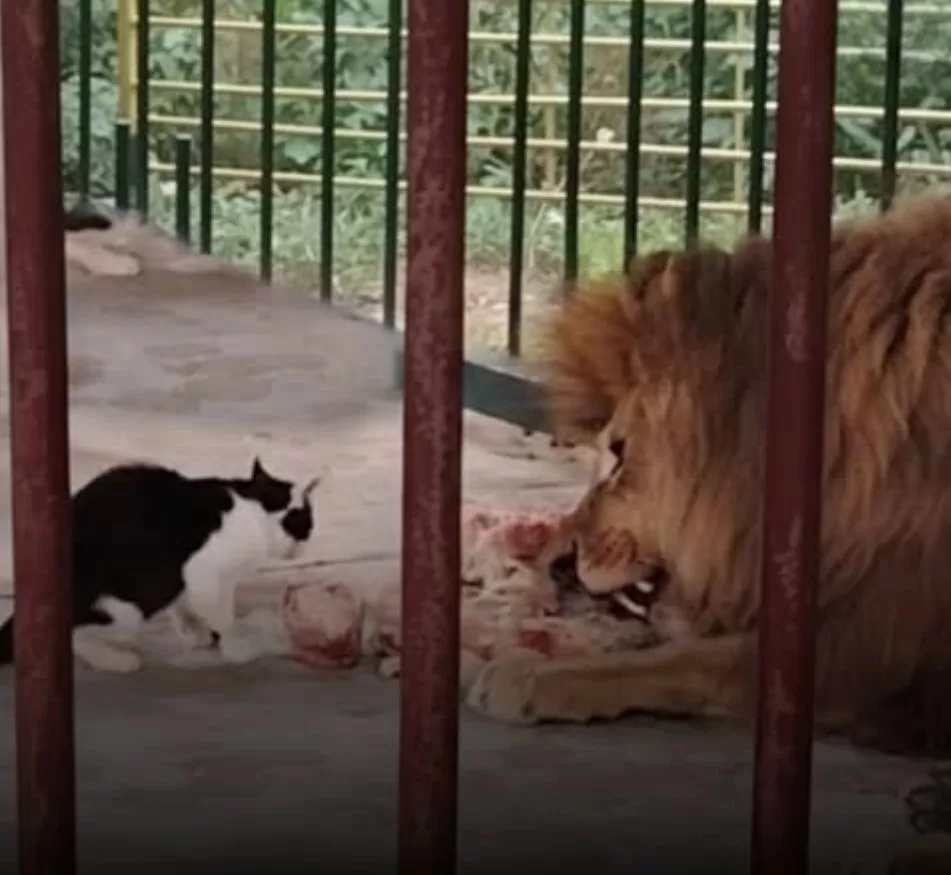

Former Circus Lion and Stray Cat: A Story of Unexpected Kindness and Healing
Animal lovers often tell the story of a former circus lion who shared his meal with a small stray cat. According to the accounts, there was no aggression, no display of dominance. Instead, the lion reportedly looked at the hungry cat for a brief moment and then nudged a piece of meat toward her, as if he understood exactly what she needed.
Over time, people say, the two grew accustomed to each other. Both had lived difficult lives. The lion had spent years in captivity, performing for audiences under artificial lights. The cat had survived on the streets, navigating hunger and uncertainty. Yet they eventually rested side by side, calm and untroubled in each other’s presence.
Whether every detail of this story is fully accurate is almost secondary.
What matters is the message it carries.
A lion is often portrayed as the embodiment of raw power and instinct. A stray cat, by contrast, is small, fragile, and frequently overlooked. The idea of such an imbalance coexisting peacefully challenges our expectations. In nature, predators and smaller animals rarely share space without tension. Yet this narrative suggests something different: that under certain conditions, even those shaped by hardship can express gentleness.
Former circus animals often endure years of confinement and strict control. When retired or rescued, they must adapt to new environments, sometimes discovering a sense of calm they were previously denied. If the story is true, the lion may have been in a sanctuary or rehabilitation setting where food was no longer scarce and survival was not defined by competition.
In such a context, behavior can change.
Animals respond to their environment. When fear and scarcity are replaced with stability and care, aggression can diminish. A well-fed lion with no need to defend territory or fight for resources may react differently than one in the wild.
At the same time, stray cats learn resilience. They survive by reading situations carefully, approaching cautiously, and retreating when necessary. The image of a small cat slowly gaining the trust of a massive lion carries emotional weight precisely because it seems improbable.
But beyond biology, the story touches on something deeply human.
It suggests that kindness can survive even after years of exploitation or hardship. A lion once forced to perform might still possess the capacity for calm companionship. A cat accustomed to fending for herself might find safety in unexpected company.
Whether the event happened exactly as described or has been shaped over time through retelling, its symbolic value remains strong.
It reminds us that warmth does not require words. Compassion does not need explanation. Sometimes, a gesture is enough.
The simple act of pushing food toward another creature carries meaning. It represents recognition. It suggests awareness of another’s need. In that moment, strength becomes protection rather than threat.
Stories like this resonate because they offer hope. They challenge the assumption that pain inevitably produces cruelty. They show that beings marked by difficult pasts can still choose peace.
Perhaps that is why animal lovers continue to share the tale.
In a world where headlines often highlight conflict, the image of a lion and a stray cat resting quietly together offers a different perspective. It speaks of healing. Of coexistence. Of the possibility that even after exploitation and suffering, gentleness can endure.
And maybe that is the true value of the story.
Not whether every detail can be verified, but that it invites us to believe that kindness can survive in the most unlikely places.


