

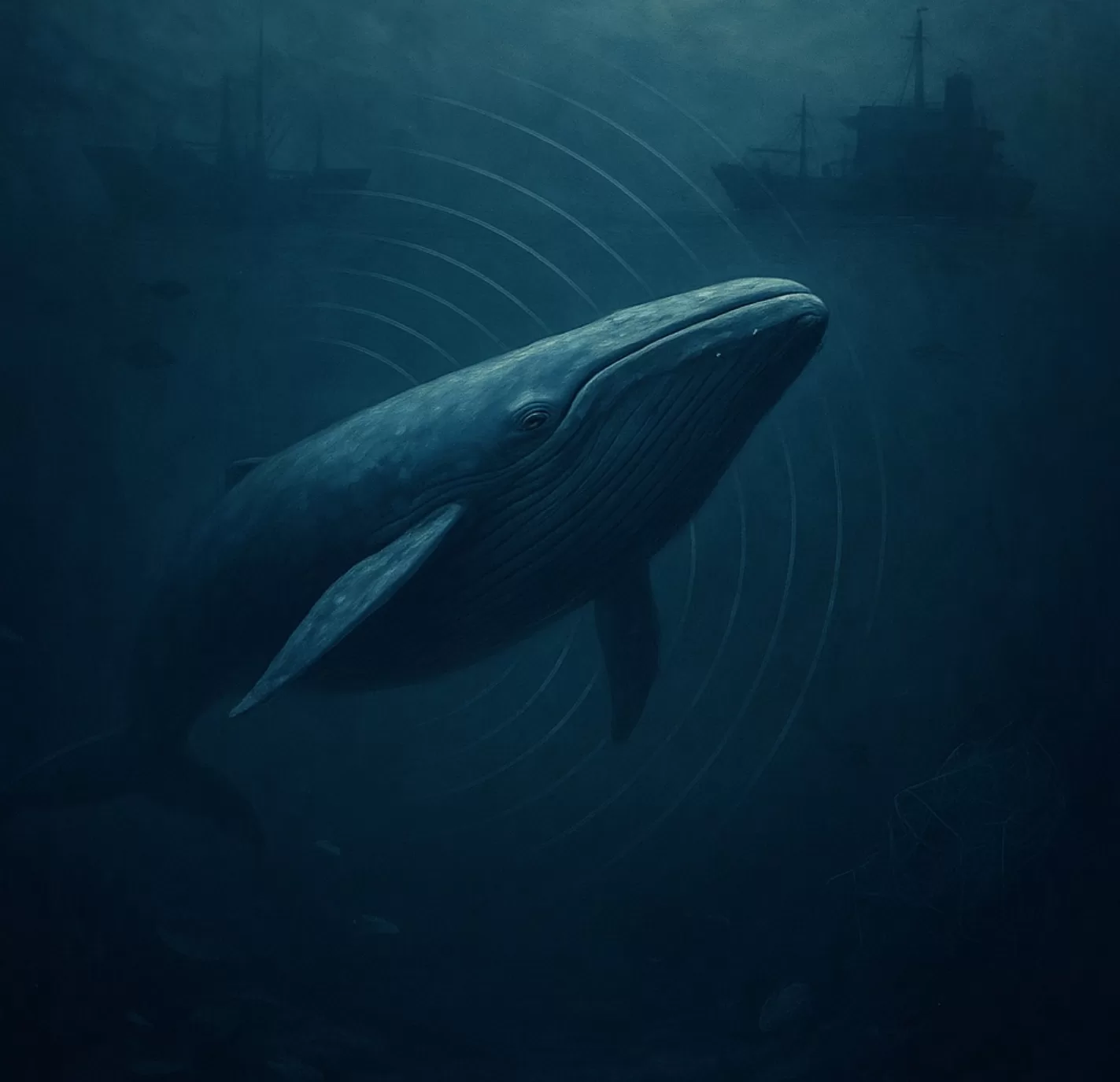

Blue Whale Songs Are Growing Quieter as Ocean Noise and Climate Threats Increase
The largest animals on the planet are becoming quieter.
In several regions of the world’s oceans, researchers have reported a decline in recorded blue whale vocalizations. Blue whales, known for producing some of the loudest sounds in the animal kingdom, rely on low-frequency songs to communicate across vast distances. These calls can travel hundreds of kilometers underwater, allowing individuals to find mates, coordinate movements, and maintain contact in the open sea.
Today, those songs are increasingly masked by human-made noise.
Commercial shipping traffic has expanded dramatically over the past century. Massive cargo vessels, tankers, and cruise ships generate continuous low-frequency sounds that overlap with the communication range of blue whales. The steady hum of engines and propellers fills key migration routes and feeding grounds. In many areas, the ocean is no longer the quiet acoustic environment it once was.
For animals that depend on sound to survive, this shift carries serious consequences.
When whale calls are drowned out, communication becomes more difficult. Mating opportunities may decrease if individuals cannot hear each other clearly. Coordination between mothers and calves can be disrupted. Over time, chronic noise exposure may also cause stress, affecting feeding patterns and overall health.
Yet shipping noise is only one part of the problem.
Climate change is altering ocean ecosystems in ways that directly impact blue whales. Rising sea temperatures influence the distribution of krill, their primary food source. As currents shift and ocean chemistry changes, krill populations can move or decline, forcing whales to travel farther for nourishment. Reduced food availability increases the risk of malnutrition and lowers reproductive success.
Historical pressures continue to cast a long shadow as well.
Although commercial whaling on blue whales largely ended decades ago, the mass hunts of the 20th century decimated their populations. Hundreds of thousands were killed during the industrial whaling era. Despite international protection, their numbers have never fully recovered. Blue whales are still classified as endangered in many regions, and their populations remain fragile.
Every individual lost today carries added weight.
Collisions with ships are a persistent threat, particularly along busy shipping corridors. Entanglement in fishing gear can lead to injury, prolonged suffering, or death. In some cases, weakened whales facing reduced food supplies are less able to survive these additional pressures.
Each death represents not only the loss of a magnificent animal but also a disruption within a delicate marine ecosystem.
Blue whales play a significant ecological role. Through their feeding and movement, they help circulate nutrients within ocean waters. Their presence supports the balance of marine food webs. When large marine mammals decline, the broader system can be affected in subtle but meaningful ways.
If we want oceans to still resonate with whale songs a century from now, action cannot be delayed.
Reducing underwater noise is possible. Shipping lanes can be adjusted to avoid key habitats. Speed limits can decrease both collision risk and acoustic disturbance. Advances in ship design can lower engine and propeller noise. These measures require coordination among governments, shipping companies, and conservation groups.
Bycatch reduction is another critical step. Improved fishing gear, better monitoring, and seasonal closures in sensitive areas can significantly decrease entanglement incidents.
Climate policy also plays a decisive role. Protecting whale populations ultimately depends on stabilizing ocean ecosystems. Meaningful reductions in greenhouse gas emissions, along with the protection of marine habitats, are essential to preserving the food sources and migration routes whales rely on.
The growing silence in parts of the ocean does not begin with the whales themselves.
It begins with human activity.
The choices made on land and at sea determine whether the world’s largest animals will continue to communicate across the depths. Blue whales are still here. Their voices have not vanished. But in many places, they are harder to hear.
Protecting them means recognizing that the health of the oceans is inseparable from our own decisions. If we wish to preserve the sound of whale songs for future generations, the responsibility rests with us now.


