


A Dog’s Love Has No Price Tag – Why True Loyalty Cannot Be Bought
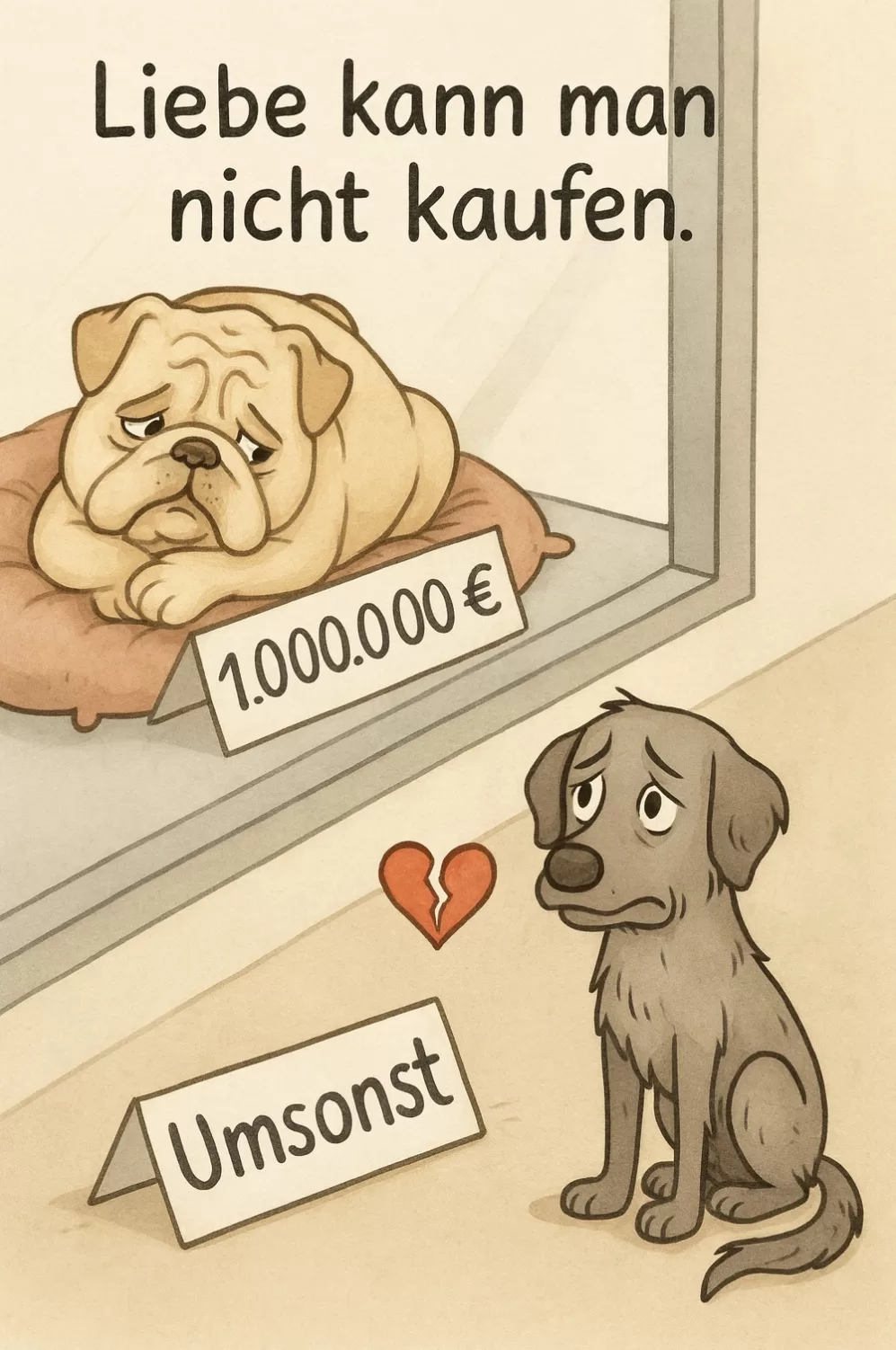
The illustration tells a simple yet powerful story. In a shop window sits a purebred dog, resting on a cushion, with a sign displaying an enormous price: 1,000,000 €. Above him are the words: “Liebe kann man nicht kaufen.” Outside the window sits another dog, thinner, overlooked, with a small sign in front of him reading “Umsonst.” Between them, a broken heart.
The message is clear.
Some dogs cost a fortune. Others are given away for free. Yet their love is always priceless.
In many parts of the world, certain dog breeds are sold for extraordinary sums of money. Pedigree, lineage, rarity, and appearance can drive prices to astonishing levels. For some buyers, owning an expensive dog becomes a symbol of status or exclusivity. The cost itself is part of the appeal.
At the same time, countless mixed-breed dogs and abandoned animals wait in shelters, often offered at no cost or for a minimal adoption fee. They do not come with certificates of pedigree. They may not fit fashionable standards. Yet what they offer is exactly the same.
Loyalty.
Affection.
Devotion.
The idea that love cannot be purchased is not new, but it becomes especially poignant when applied to animals. A dog does not calculate the price paid for it. It does not measure its affection based on financial value. Whether acquired for a high sum or adopted without cost, a dog bonds with the person who feeds, protects, and cares for it.
From the dog’s perspective, there is no difference.
The illustration also hints at a deeper social reflection. Sometimes, value is assigned externally. A high price suggests importance. A free sign suggests lesser worth. Yet emotional worth does not follow economic logic. A dog given away for free can love just as fiercely as one that cost a fortune.
Shelters around the world are filled with animals who were once purchased at high prices and later abandoned. The initial cost did not guarantee commitment. Meanwhile, families who adopt rescue dogs often describe extraordinary bonds built on gratitude and trust.
This contrast challenges the way society equates price with value.
When someone chooses a dog based solely on status, appearance, or prestige, they may overlook what truly matters. A dog’s love is not enhanced by a pedigree certificate. It is strengthened by care, patience, and shared experience.
The broken heart between the two illustrated dogs adds another layer of meaning. It may represent the emotional divide created when animals are treated as commodities. Or it may reflect the sadness of overlooked animals who sit outside windows, unseen despite their capacity for deep attachment.
In reality, dogs do not judge themselves based on market price. They do not compete in economic terms. Their world revolves around connection. They thrive on belonging and stability. Whether born in a breeder’s facility or rescued from the street, their emotional response to kindness is consistent.
Love given to them is returned without calculation.
Perhaps the most important takeaway is this: choosing a dog should never be about the price tag. It should be about readiness to provide lifelong care. A dog’s needs remain the same regardless of purchase price. Time, attention, veterinary care, exercise, and emotional presence are what define a successful relationship.
In the end, some dogs may come with impressive price labels, while others may be offered freely. But once they curl up beside their human, once they wag their tail at the sound of a familiar voice, once they wait patiently by the door for someone to return home, the economic distinction fades completely.
Their love cannot be bought.
It can only be earned and returned.
And that is what makes it priceless.


