


When Warmth Becomes Something You Are Afraid to Lose
Outside, it was one of those nights where the cold does not stop at the paws. It creeps deeper, slowly, until it settles somewhere close to the heart. Snow lay over everything like a thin, rigid sheet, and the wind turned every corner into a place you instinctively knew you should not stay.
That was the night she appeared.
Between old planks and stacked firewood stood a small tabby cat. She was far too still for an animal that should have run at the first sound. There was no curiosity in her posture. No boldness. No trace of mischief. Only exhaustion. The kind of careful, guarded tiredness that forms when a living being has learned, again and again, that calling out leads nowhere.
Someone found her behind a shed, pressed close to where a faint bit of warmth leaked through the cracks. She was no longer shivering violently. Instead, her body trembled slowly, deliberately, as if it had decided to conserve what little energy remained. When a hand reached out, she did not pull away. She only lifted her head slightly, her eyes asking a quiet question. Are you going to leave again?
Inside, it was warm.
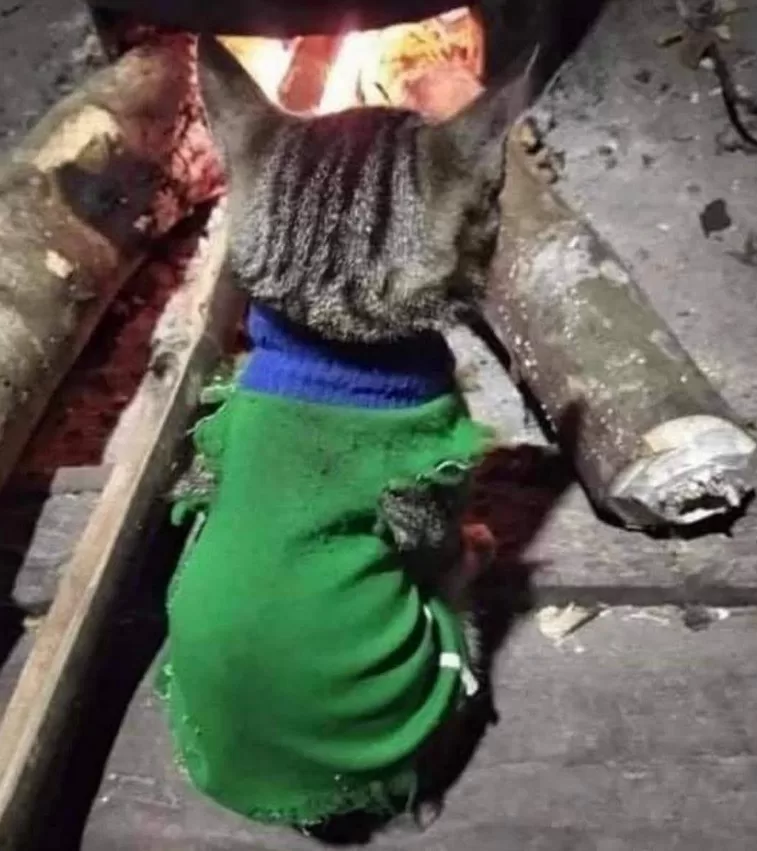
Wood cracked softly in the stove, and light flickered against the walls. The cat moved straight toward the heat source and settled as close as she could. Too close. Close enough to make anyone watching worry she might burn herself. But she did not move away. As if warmth was not something to enjoy casually, but something to cling to before it disappeared.
That alone said more than any sound she could have made.
The next day, someone brought an old child’s sweater. Too small for a person, but just right for a fragile body that still had to survive winter nights. It was carefully adjusted, a few stitches sewn by hand, an opening made so it would not press or restrict her. When it was gently slipped over her, she froze.
Not because it hurt.
But because she did not understand.
She did not understand why someone would take time. Why someone would make an effort without demanding anything in return. She stood stiff and uncertain, caught between instinct and disbelief.
Then something unforgettable happened.
She walked back to the stove, now wearing that green, frayed sweater, and lay down in the warmth. Her breathing slowed. Not the shallow, guarded rhythm of exhaustion, but the deeper, steadier breath of something else. For the first time, it looked as though she might truly sleep.
Not because her body had given up.
But because she felt safe.
Scenes like this do not rely on drama. There is no loud rescue, no heroic soundtrack, no triumphant moment. And yet, they can be harder to forget than any spectacular story. Sometimes it is not tragedy itself that breaks you. Sometimes it is this small image. An animal that has been cold for so long that warmth feels like a miracle.
It forces a difficult realization.
Cold does not always announce itself with obvious danger. It wears animals down quietly. It teaches them to expect nothing. To conserve energy. To stop asking. By the time someone notices, survival has already become a careful calculation instead of a natural state.
That cat did not cry for help. She did not beg. She waited. And waiting, in those conditions, is its own kind of suffering.
Looking at her curled up by the stove, wrapped in a sweater meant for a child, it becomes impossible not to think further. If a piece of clothing and a warm place can change so much, how many others might have been saved if someone had looked sooner. If someone had noticed the stillness. The quiet. The absence of fear that is no longer bravery, but resignation.
This story is not about charity or grand gestures. It is about attention. About seeing what is easy to overlook. About understanding that warmth, safety, and care are not luxuries for animals living outside. They are the difference between enduring and living.
The cat did not suddenly become playful or affectionate. She did not transform overnight. Healing, especially after prolonged exposure to cold and neglect, takes time. But that moment by the stove marked a shift. From survival to rest. From vigilance to trust.
And that trust did not come from words or promises. It came from consistency. From a warm room that did not disappear. From hands that adjusted a sweater simply because it was needed.
Sometimes the world does not need another reminder of how cruel it can be. Sometimes it needs to remember how small acts matter. How a place by the fire and a worn sweater can give an exhausted body permission to sleep.
In moments like this, the thought comes uninvited and heavy. If so little can mean so much, then the tragedy is not that help is impossible. It is that it often arrives too late.
All it takes to change a life is noticing the cold before it becomes fatal.


