


When Imitation Became an Act of Love
In Rio de Janeiro, a simple moment between a child and her dog turned into something that resonated far beyond one family. It did not involve a grand gesture, a speech, or a carefully planned idea. It involved a three year old girl, a rescued puppy, and a decision made with complete innocence.
The girl’s name is Leticia. She is three years old, an age where the world is still understood through feeling rather than explanation. Her puppy, Francisco, had been rescued earlier and quickly became part of her everyday life. He followed her around, slept nearby, and existed in that quiet way animals do when they have found safety.
One day, Leticia noticed something about him.
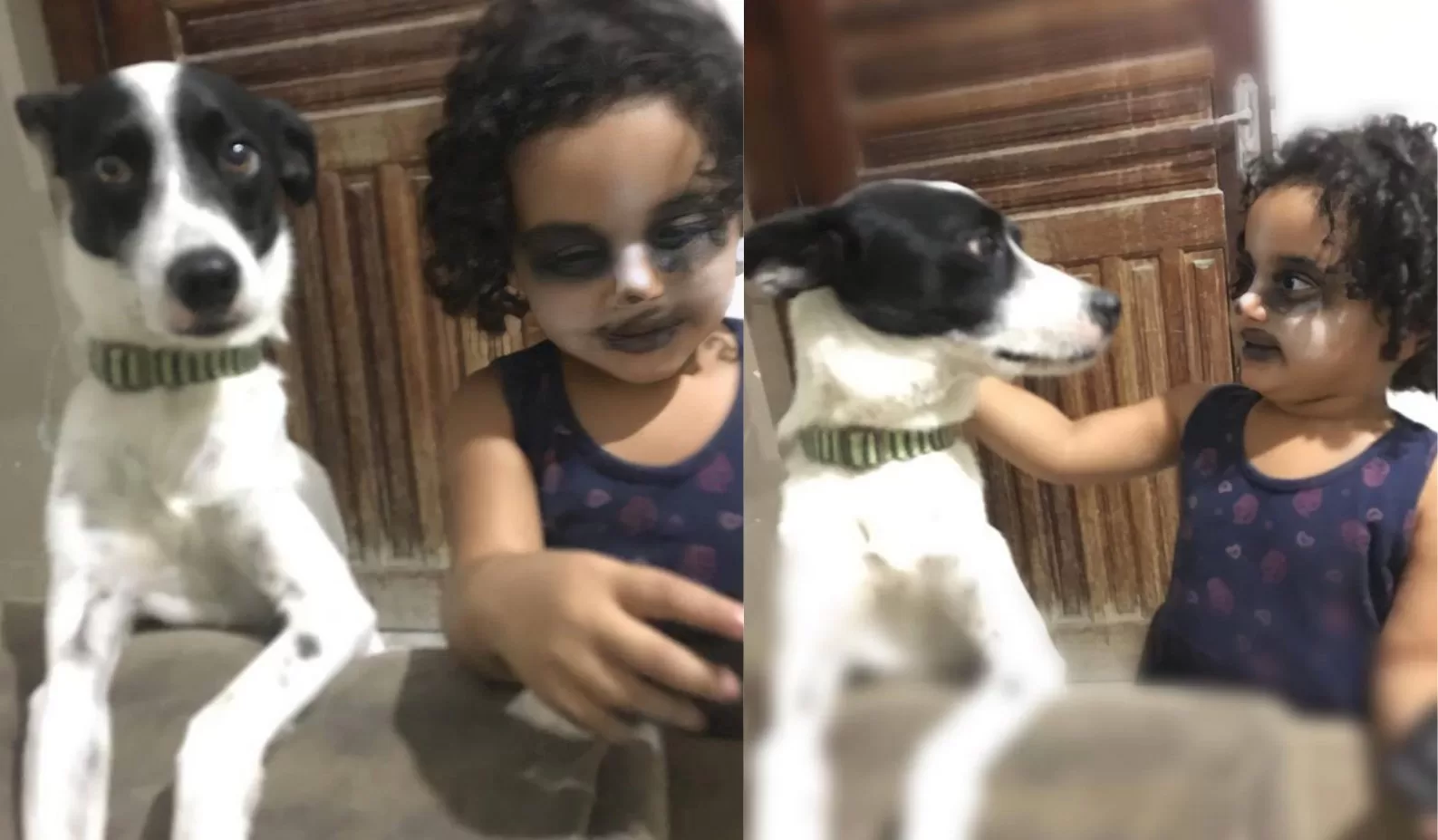
Francisco had dark spots around his eyes. Not something that bothered anyone. Not something unusual. Just part of how he looked. But to Leticia, those marks stood out. She observed them carefully, the way children do when they are truly curious. And then, without asking for help or permission, she acted.
She quietly took her mother’s makeup.
No one knows exactly what she was thinking in that moment. Children rarely explain their motivations. But what she did next was clear. Leticia drew the same dark spots around her own eyes. She did not exaggerate them. She did not laugh or turn it into a game. She simply wanted to look like Francisco.
To be the same.
When her mother discovered what had happened, she did not scold her. Instead, she paused and watched. The scene was gentle and unforced. Leticia stood there with makeup on her face, looking at her puppy, proud and calm. The moment was filmed, not because it was meant to go viral, but because it felt special.
When the video was later shared, it spread rapidly.
People from all over the world reacted to it. Many commented that Leticia was trying to be closer to her best friend. And that interpretation felt right. There was no performance in her behavior. No awareness of an audience. Just a child expressing connection in the most literal way she knew how.
Children often imitate what they love. They repeat words, gestures, and behaviors not to mock, but to belong. For Leticia, looking like Francisco was not about copying a dog. It was about erasing difference. About saying, in her own way, you and I are the same.
That is what made the moment so powerful.
In a world where differences are often highlighted, corrected, or questioned, this small act carried a quiet message. Leticia did not see the spots as flaws or oddities. She saw them as part of someone she loved. And love, to a child, is something you join, not something you analyze.
Francisco, unaware of the attention, simply remained himself. He did not react dramatically. He did not move away. He stayed close. That closeness, unspoken and natural, completed the picture.
What touched so many people was not the makeup itself. It was the intention behind it. Leticia did not try to change Francisco. She changed herself instead. Not because she was told to, but because it felt right.
The story spread quickly, but its impact was not based on novelty. It was based on recognition. Many people saw in that moment something they had lost touch with. A time when acceptance was instinctive. When love did not require explanation or justification.
This was not a trend. Not a challenge. Not a staged act designed for attention. It was a private decision made by a child who wanted her friend to feel less alone in how he looked.
Her mother later explained that Leticia and Francisco spend most of their time together. They play, nap, and exist side by side. For Leticia, the puppy is not a pet in the abstract sense. He is a companion. A constant presence. Someone who belongs.
That belonging is mutual.
Rescue animals often carry visible signs of their past. Marks, scars, or features that set them apart. Adults tend to notice these differences first. Children often do not. Or when they do, they respond in ways that are disarmingly pure.
Leticia did not ask why Francisco looked the way he did. She did not wonder whether it was normal. She simply adjusted her own reflection to match his.
There is something quietly instructive in that.
It reminds us that acceptance does not have to be taught. Sometimes it exists naturally, before the world complicates it. Before people learn to separate, label, or correct.
The video eventually reached millions, but its meaning remained unchanged. It was never about going viral. It was about a child who wanted to stand beside her friend, even in appearance.
Moments like this stay with people because they are rare in their honesty. They do not ask for applause. They do not demand interpretation. They simply exist.
And in that existence, they remind us of something simple and often forgotten.
Love, at its purest, does not try to fix what is different.
It joins it.
Sometimes, that is enough to soften hearts everywhere.


